Очистка воды |
 |
тел.: (495)755-64-37, |
 | |||||||
 |
 |
 |
 |
 |
 |
||
| |||||||
| | The "Ecoservice Technochim-M" firm residing in Moscow was set up in 1991. The workers of the firm are high-qualified specialists in the area of chemistry, ecology and power technology. They have a significant experience of complex solution of water purification problems. Main directions of activity
The "Ecoservice Technochim-M" is efficiently solving tasks related to treatment of cold water for consumer needs coming from various sources (removal of hardness salts, iron, manganese, hydrogen sulphide, elimination of bacteria), and hot water (removal of various admixtures and bacteria generating ferriferous odor from pipelines and contours). The firm performs the full range of work (starting with laboratory analysis of water), it has at its disposal unique proprietary equipment, quality domestically-produced and imported systems enabling to bring water from practically any source up to the level of potable water. The activity of the "Ecoservice Technochim-M" firm is licensed (License №МСЛ 055822). "TERMIT", AN ELECTRONIC HARDNESS SALTS CONVERTER
The "Termit" consists of
Operating principle. The generated radio frequency signals (1-10 kHz) are transmitted by radiating wires coiled to the pipeline. While passing through water flowing in the pipeline the electromagnetic radiation alters the structure of hardness salts with a brittle aragonite form of calcium carbonate produced. The result is that no tough amorphous salts deposits are formed. Moreover, deposits having formed earlier are destroyed and carried away with water flow. At the same time, the water does not lose any chemical elements, that is, its quality as potable water is preserved. Technical characteristics
At the customer's request, radiating wires with a thermally stable insulation withstanding temperatures of up to 115°C can be installed. The "Termit" is efficiently used in the following systems:
There are specifications for the facility, a hygienic permit and certificate of correspondence. Cooperation proposals
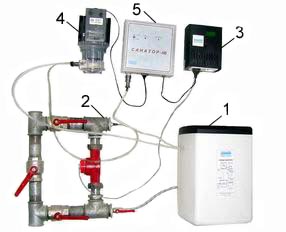
"SANATOR", A FACILITY FOR DISINFECTION OF WATER AND OF WATER-PURIFICATION EQUIPMENTThe electrochemical facilities "Sanator" provide for decontamination of water and disinfection of water-purification equipment. The operating principle of the facility consists in performing preparation of the disinfecting solution of sodium hypochlorite by electrolysis of 2-4% water solution of common salt directly in the "Sanator"; the hypochlorite solution (an effective oxidizer and disinfectant) is continuously or by portion fed into the water-purification system. The "Sanator" consists of an electrode cassette, a hard common salt solvent, a float chamber, a finished product collection chamber (placed in one case) and a power supply source. The complete set incorporates a dosing-out pump of the peristaltic or membrane type and a microcontroller to regulate the hypochlorite feeding. It is possible to produce facilities with capacity by sodium hypochlorite of up to 2 kg/hour. The "Sanator" is used for the following purposes:
Technical characteristics
* Depends on degree of its contamination
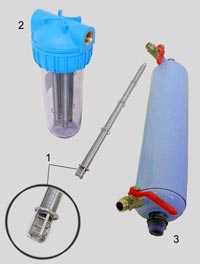
The facility is batch-produced. There is a hygienic certificate of the Ministry of Health Care of the RF and specifications. The "Sanator" is protected by patents of the RF. FILTERS FOR MECHANICAL WATER PURIFICATIONThe filters are designed for highly efficient purification of cold and hot tap water from mechanical impurities. The filters design. FEK filtering elements (their number is determined by the required productivity of the filter) produced as compactly wound coil springs from stainless steel are installed in a metal or plastic casing of the device. A subsidiary filtering layer of perlite about 3 mm thick is washed in on the elements' surface (perlite has been certified for food liquids filtering). The filter with a washed-on layer is capable of trapping particles with linear sizes of more than 1 u.m and possesses sorption properties as related to organic admixtures. Before the filter starts operating perlite powder (0.6-0.7 litre) is mixed with water. The obtained suspension (up to 2 litres in volume) is poured into the apparatus through a funnel 10 and tap 7. After loading tap 7 is turned off and taps 6 and 2 are turned on. The water flow captures the perlite and washes it in on the outer surface of the FEK. The water being purified goes through tap 2, comes to the subsidiary filtering perlite layer 3 and goes through filtering elements FEK. Purified water goes into the collector 4 and to the consumer through tap 6. Regeneration of the filter is performed by reverse water flow with tap 2 turned off and taps 6, 8 9 turned on for 5-10 seconds. If water purified contains a significant amount of clay (for example, in some regions of China) there is no need to use perlite to form a filtering layer, the latter is formed from clay suspension in water.
The main advantage of the offered devices as compared with other sorption filters is the fact that the filtering elements can undergo a practically unlimited number of "filtration-regeneration" cycles with no irreversible clogging of the filtering material's pores. It is accomplished due to the "semiconductor" properties of the filtering element, that is, at filtering the water flow fed from outside of the element compresses the filtering spring coils, and, at regeneration, the reverse flow stretches them from inside which facilitates destruction of the particles layer and ensures access of water to the whole filtering surface. FEK can be used to assemble filtering devices of different productivity. Advantages the filters offer were experimentally confirmed while filtering different liquids. The producer guarantees a long-year operation of the filters and the author's supervision of the product during all the warranty time.
Cooperation proposals
|
|
|




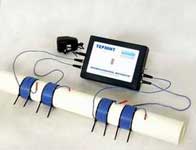 The batch-produced electronic hardness salts converter "Termit" is intended for protection and cleaning of various objects and equipment from hardness salts deposits.


|
|